

RFID vs. Barcode Labels: Which Is Better for Manufacturing and Asset Tracking?
RFID vs. Barcode Labels: Which Is Better for Manufacturing and Asset Tracking?
Manufacturers rely on accurate tracking systems to keep inventory organized, monitor valuable assets, reduce errors, and improve efficiency throughout their operations. Two of the most common technologies used for this purpose are RFID labels and traditional barcode labels.
While both technologies can help businesses identify and track products, parts, equipment, and inventory, they work in very different ways. Understanding the differences between RFID and barcode labels can help manufacturers determine which technology makes the most sense for their operation.
What Is RFID?
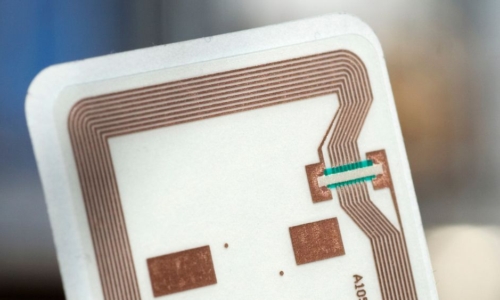
RFID, or Radio Frequency Identification, uses radio waves to transmit information between an RFID tag and a reader. An RFID label typically contains a small embedded chip and antenna that stores information associated with an individual product or asset.
Unlike traditional barcode technology, RFID tags generally do not require a direct line of sight to be read. Depending on the RFID system and application, multiple tagged items may also be read without individually scanning each label.
For manufacturers managing large amounts of inventory or equipment, this can make RFID a powerful tool for automating tracking processes.
RFID technology can be used for applications such as:
- Inventory management
- Asset tracking
- Work-in-process tracking
- Equipment identification
- Supply chain visibility
- Product authentication
- Warehouse management
How Do Traditional Barcode Labels Work?
Barcode labels store information in a printed pattern that is read using a barcode scanner or compatible camera. The barcode typically connects the physical item to information stored in a company’s inventory, ERP, warehouse management, or asset management system.
Barcodes remain extremely common in manufacturing because they are relatively inexpensive, simple to implement, and compatible with many existing systems.
However, traditional barcode scanning generally requires the barcode to be visible to the scanner. Employees may need to locate and scan products individually, which can become time-consuming when managing large quantities of inventory.
RFID vs. Barcodes: What’s the Difference?
The biggest difference between RFID and barcode technology is how information is captured.
A barcode needs to be visually scanned, while an RFID tag communicates using radio frequency technology. This means an RFID reader may be able to capture information from tags without requiring workers to manually position each label in front of a scanner.
Another major difference is the amount and type of information the technology can support. RFID tags can provide unique identification for individual assets and can be incorporated into more automated tracking systems.
Barcode systems, meanwhile, can be an excellent choice when a business needs straightforward identification at a lower implementation cost.
Is RFID Better for Manufacturing?
RFID can offer significant advantages in manufacturing environments where speed, automation, and real-time visibility are important.
For example, imagine a manufacturer needs to verify dozens of components moving through a particular production stage. With traditional barcodes, employees may have to scan those components individually. An appropriately designed RFID system can potentially capture multiple tagged items more efficiently.
This can help manufacturers improve inventory accuracy, reduce manual data entry, and gain better visibility into where products, components, or equipment are located.
RFID can be particularly valuable for manufacturers with high-value assets, large inventories, complex production processes, or frequent movement of materials.
However, RFID isn’t automatically the best solution for every application. Cost, reading environment, materials, range requirements, existing systems, and the surface where the label will be applied all need to be considered.
When Are Barcode Labels the Better Choice?
Traditional barcodes continue to be an effective solution for many manufacturing applications.
If items only need to be scanned individually at specific points in a process, a barcode system may provide everything the manufacturer needs without the additional infrastructure associated with RFID.
Barcodes can be a strong choice for applications where:
- Cost is a major consideration
- Individual scanning is acceptable
- Existing barcode infrastructure is already in place
- Products are easily accessible for scanning
- Advanced automated tracking isn’t necessary
The right choice ultimately depends on the manufacturer’s workflow and tracking requirements.
Can Manufacturers Use RFID and Barcodes Together?
Yes. Manufacturers don’t necessarily have to choose one technology exclusively.
An RFID label can also incorporate printed barcodes, serial numbers, product information, branding, and other identification elements. This allows manufacturers to build a flexible identification system that supports multiple tracking methods.
A hybrid approach can also help businesses transition toward RFID while maintaining compatibility with existing barcode-based processes.
Choosing the Right Tracking Label for Your Application
Whether RFID or traditional barcode technology is better depends on what you’re tracking, your environment, how quickly items need to be identified, and how your tracking system integrates with the rest of your operation.
Just as important is choosing a label construction capable of surviving the environment where it will be used. Heat, chemicals, moisture, abrasion, outdoor exposure, and challenging application surfaces can all affect label performance.
Impact Label works with manufacturers and OEMs to develop custom identification and tracking solutions designed around real-world applications. From durable barcode and identification labels to RFID-enabled solutions, the right combination of materials, adhesives, printing, and technology can help create a tracking system built for your operation.
Need help determining whether RFID or barcode labels are right for your application? Contact Impact Label to discuss your manufacturing and asset-tracking requirements.